Incorporate CHO concepts
CHO Appreciation Award 2026
About Chief Happiness Officer Association (CHOA)
The Chief Happiness Officer Association Limited (CHOA) is a non-profit organization founded in 2021. Over the last five years, we have created a platform for corporations and small-medium sized companies (SMEs) to share and feature their best practices at our annual CHO Appreciation Award event and presentation. So far, over 110 organizations, including corporations and SMEs, have participated and showcased their good practices in creating a positive workplace culture that motivates their employees to excel at work.
In view of the growing convergence towards Environmental, Social and Governance (ESG) reporting and Sustainable Development Goals (SDGs), many organizations have heightened their knowledge to align their corporate strategies in addressing global concerns towards ESG and SDGs. This converging trend is a positive indication that Hong Kong remains an international city whose employers remain focused in sustaining the thriving energy amongst their workforces. CHOA has witnessed these exemplary practices over the last five years (2021-2025). Therefore, CHOA considers that this is a critical juncture when the Chief Happiness Officer (CHO) movement should place more emphasis in supporting organizations in Hong Kong to align with the world trends in advancing the principles of ESG, SDGs, and relevant ISO certifications (e.g., ISO26000).
Therefore, we believe that corporations can take the lead in the CHO movement by transforming and re-energizing organizational culture. When employees are well supported, they can develop happiness-driven performance, which not only enhances productivity but also creates a ripple effect that positively impacts their families and the broader community.
1. introduction
In an era defined by AI, digital transformation, and evolving workforce expectations, organizations recognize that thriving depends not only on performance but on purpose, culture, and people experience. The future of work means going beyond resilience to build environments where people can truly thrive.
The Chief Happiness Officer Appreciation Award 2026 embraces the theme:
“Co-Creating a Thriving and Sustainable Happy Workplace”. This reflects a shift from delivering happiness as an initiative to co-creating flourishing workplace ecosystems through shared ownership among leadership, employees, and the wider organization.
At the Chief Happiness Officer Association (CHOA), we believe that thriving workplaces are built through collective engagement, purposeful leadership, and people-centred practices. Organizations that actively involve their people in shaping culture can unlock higher levels of engagement, innovation, and sustainable performance while developing employees who sustain a culture of continuous learning and chart new courses. Thriving employees are the key to managing challenges impacted by evolving geopolitics and advancing AI technology.
Moreover, CHOA recognizes the importance of building an ecosystem aligned with ESG priorities and the United Nations Sustainable Development Goals (SDGs). Therefore, the CHO Appreciation Award 2026 continues to recognize excellence in:
- Corporate Governance Stewardship (Employee Happiness Strategies)
- Employees’ Wellbeing Initiatives
- Organizational Culture Development and Digital Transformation
In 2025, CHOA launched the Workplace Happiness Index, a pioneering multi-level initiative that captures workplace happiness from both senior leadership and employee perspectives. As an ongoing study, it provides an integrated view of how organizational culture and leadership practices translate into employee thriving, performance, and sustainable impact.
In today’s transformation landscape, best-performing organizations are those that enhance human potential through technology, foster psychological safety, and cultivate flexibility and ongoing learning.
More than a recognition platform and an annual event, the CHO Appreciation Award functions as a community for shared learning and an impetus for sustainable cultural transformation.
We invite forward-thinking organizations to join us in forming the future of work—where happiness drives performance, thriving becomes the norm, and sustainability becomes the legacy.
2. OBJECTIVES OF THE AWARD
- To honor, award and collaborate with organizations and their people development teams for their tremendous effort in driving employee wellbeing and happiness in their corporate culture.
- To establish a Chief Happiness Officer database of corporate happiness stories.
- To promote awareness of employee physical and mental health initiatives within organizations.
- To highlight innovative approaches that leverage digital transformation to enhance employee experiences, streamline processes, and promote a happy workplace.
- To establish an active exchange of best practices among the awardees and other community members.
3. BENEFITS TO ORGANIZATIONS
- To cement the credibility and public recognition of the organization in the business community.
- To validate your hiring strategy and attract potential talents to join your organization.
- To enhance the employer branding and reputation of the organization through showcasing their best practices.
- To recognize the achievements of your employees and boost morale as well as motivation.
4. ELIGIBILITY
The Chief Happiness Officer Appreciation Award 2026 is open to organizations of any size or business nature in Hong Kong. These organizations are encouraged to share their existing Corporate & HR policies, practices, systems or recent events that are related to wellbeing and a happiness-driven culture in the application form. The examples should be implemented in the past 24 months (namely between 1 July 2024 to 30 June 2026) for their employees.
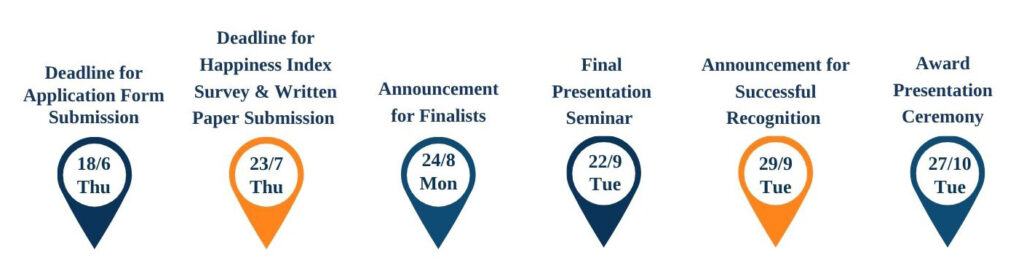
5. key dates
6. AWARD ORGANIZING COMMITTEE
Chairperson
- Ms. Annie Cheung – Executive Director, Peoplebank Hong Kong Limited
Vice-Chairperson
- Mr. Wong Kapo – Training Manager, Sanfield (Management) Limited
Committee Members
- Mr. Bruce Au – Consultant, Talent and Leadership Development, Arup
- Mr. Joe Lee – Senior Manager, Talent Development, Bupa (Asia) Limited
- Ms. Candy Mau – Director of Corporate Communications and General Administration Division, Canon Hong Kong Co., Limited
- Ms. Carmen Chan – Assistant HR & Admin Manageress, Champion Group International Limited
- Dr. Bessie Chong – Assistant Director, College of Business, City University of Hong Kong
- Dr. Susanna Chui – Lecturer in Entrepreneurship, Leicester Castle Business School, De Montfort University, the UK
- Ms. Anita Lai – Director of Membership, EGN (Hong Kong) Limited
- Ms. Sarah Cheuk – Head of People, FANO Labs Limited
- Ms. Jo Ling – Wellness Leader, Gammon Construction Limited
- Mr. Lurlee Leung – Head of Talent Development, Nan Fung Group
- Ms. Beryl Watt – Director, Chief Executive’s Office, Ocean Park Corporation
- Ms. Adele Chu – Corporation Cultural Practitioner
7. AWARD CATEGORIES
7.1 Company Award
- Organizations with over 50 employees can apply for the Company Award, Special Awards and compete for The Top 10 Happy Companies to Work For Award.
- The organizations that can demonstrate the CHO practice in the 3 key areas of: Corporate Governance Stewardship (Employee Happiness Strategies), Employees’ Wellbeing Initiatives, and Organizational Culture Development & Digital Transformation.
- Corporate Governance Stewardship (Employee Happiness Strategies) emphasizes the stewardship of building a thriving corporate workplace for employees, aiming to attract and retain talent, with a positive culture that impacts employee satisfaction, turnover rate, and operational costs in the long run.
- Employees’ Wellbeing Initiatives focus on creating coherent programmes/initiatives, for enhancing physical and psychological conditions for corporate employees, that aim at achieving employee wellbeing. These programmes/initiatives should align with the corporate stewardship’s vision.
- Organizational Culture Development & Digital Transformation focuses on the adoption of technology in enhancing employee satisfaction and happiness, and successfully demonstrating changes in business processes and work efficiency.
- Organizations that achieve a total score that exceeds 70% will be granted the Company Award.
7.2 Top 10 Happy Companies to Work For Award
- Top 10 Happy Companies to Work For Award serves as the Grand Award of the Year.
- It serves to recognize the most outstanding organizations that create a happy and healthy workplace with unique and extraordinary showcases. These organizations act as a role model employer in Hong Kong.
- The awarded organization can demonstrate its strength in promoting employee engagement, thriving employee experience, digital transformation, people transformation, psychological wellness and innovation in building a happiness culture.
- It will be granted to the organizations that attain top 10 highest scores under the Company Award.
7.3 SME Award
- Organizations with 50 employees or below can apply for the SME Award, Special Awards and compete for The Top 5 Happy SMEs to Work For Award.
- The organizations that can demonstrate the CHO practice in the 3 key areas of: Corporate Governance Stewardship (Employee Happiness Strategies), Employees’ Wellbeing Initiatives, and Organizational Culture Development & Digital Transformation.
- Corporate Governance Stewardship (Employee Happiness Strategies) emphasizes the stewardship of building a thriving corporate workplace for employees, aiming to attract and retain talent, with a positive culture that impacts employee satisfaction, turnover rate, and operational costs in the long run.
- Employees’ Wellbeing Initiatives focus on creating coherent programmes/initiatives, for enhancing physical and psychological conditions for corporate employees, that aim at achieving employee wellbeing. These programmes/initiatives should align with the corporate stewardship’s vision.
- Organizational Culture Development & Digital Transformation focuses on the adoption of technology in enhancing employee satisfaction and happiness, and successfully demonstrating changes in business processes and work efficiency.
- Organizations that achieve a total score that exceeds 70% will be granted the SME Award.
7.4 Top 5 Happy SMEs to Work For Award
- Top 5 Happy SMEs to Work For Award serves as the Grand Award of the Year for SME.
- It serves to recognize the most outstanding SMEs that create a happy and healthy workplace with unique and extraordinary showcases. These organizations act as a role model employer in Hong Kong.
- The SME(s) that can demonstrate its strength in promoting employee engagement, thriving employee experience, digital transformation, people transformation, psychological wellness and innovation in building a happiness culture.
- It will be granted to the SMEs that attain top 5 highest scores under the SME Award.
7.5 CHO Special Awards
A number of Special Awards will also be granted to the organizations and SMEs with outstanding showcases in different individual areas. Each organization can enroll up to 2 CHO Special Awards. The details of CHO Special Awards are:
- Shared Value Award – recognizes exemplary organizations in adopting excellent employee engagement and experience strategies. These strategies can create positive and sustainable impact for employees, organization and society.
- Digital Transformation Award – recognizes exemplary organization in adopting technology and digital solutions to enhance employees’ satisfaction and happiness level. The new digital implementation can demonstrate both fundamental and/or transformational changes to business process and efficiency.
- Best Innovative Culture Award – recognizes organization in providing innovative strategy to create a happy culture for the employees. These strategies can demonstrate innovation in their concept, design and implementation for making a successful culture shift.
- People Transformation Award – recognizes organizations in empowering their employees through upskilling and reskilling training programmes to drive business growth and organizational future success. The initiatives that can demonstrate support for employees in talent transformation and development, aligning with the company’s sustainable development strategy.
- Team Performance Award – recognizes the contribution of a team demonstrating impact, growth and ownership in the organization. The team is capable of demonstrating their alignment in shared values and vision and working towards a common objective.
- Employees Wellness Award – recognizes organizations in providing compelling strategies that include psychological, financial and wellness considerations for employees. These strategies can contribute to employees’ satisfaction, retention, and the operation cost in the long run.
- Entrepreneurial Mindset Award – recognizes organizations that can create and sustain a culture in empowering employees to propose creative and innovative solutions for process enhancement, product/service innovation, improved service efficiency / comprehensiveness or new project initiatives that demonstrate exemplary citizenship for internal or external stakeholder relations building. Participating organizations can also demonstrate how employees embrace a sense of ownership and entrepreneurship in business value and impact creation.
7.6 Individual Award
An Individual Award will be granted to a candidate who can demonstrate unmatched tenacity and dedication to happiness in the organization as well as to the community. Each organization can enroll candidates without limit to compete for the Individual Award. The details of Individual Award are:
- “Be My Own CHO” Individual Award – recognizes the contribution of individuals promoting happiness culture in their workplace. The candidate is an inspiring and positive influencer for bringing happiness in the organization as well as to the community.
8. partIcipation fee
Award Categories | Corporations (>50 employees) | SME (≤50employees) | Participation Fee |
Company Awards (Top 10 Happy Companies to Work For Award will be selected by the judges) | ✓ | – | HK$6,800 |
SME Awards (Top 5 Happy SMEs to Work For Award will be selected by the judges) | – | ✓ | HK$3,000 |
“Be My Own CHO” Individual Award | ✓ | ✓ | HK$2,500 per Enrollment |
Special Awards
| ✓ | ✓ | HK$2,500 per Award |
- The participation fee includes 2 tickets to the Award Presentation Ceremony and an Executive Summary of the Happiness Index Survey. The full report and a consultancy session will be offered at the fee of HK$3,000 per organization / SME. Details and arrangements will be shared after the announcement of winning results.
- A 50% discount is offered to non-governmental organisations (NGOs) registered under Section 88 of the Inland Revenue Ordinance of Hong Kong.
- Members of the Chief Happiness Officer Association / companies that have participated in the previous CHO Appreciation Award can enjoy a 10% discount on the participation fee.
- Early-bird discount: Organizations that register on or before 29 May 2026 (Friday) can enjoy a 10% discount on the participation fee.
- The offers may not be used concurrently.
9. JUDGING PROCESS – COMPANY AWARD, SPECIAL AWARDS, INDIVIDUAL AWARD & TOP 10 HAPPY COMPANIES TO WORK FOR AWARD

| Judging Process | Details |
Part 1 Application Form Submission (by 18 June 2026) |
|
Part 2 Happiness Index Survey Submission (30%) (by 23 July 2026) |
|
Part 3 Written Paper Submission (20%) (by 23 July 2026) |
Supplementary Information:
|
Part 4 Final Presentation Seminar (50%) (22 Sept 2026) |
|
10. JUDGING PROCESS – SME AWARD, SPECIAL AWARDS, INDIVIDUAL AWARD & TOP 5 HAPPY SMEs TO WORK FOR AWARD
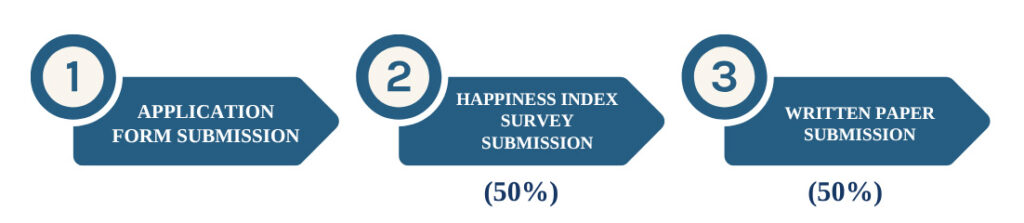
| Judging Process | Details |
Part 1 Application Form Submission (by 18 June 2026) |
|
Part 2 Happiness Index Survey Submission (50%) (by 25 July 2024) |
|
Part 3 Written Paper Submission (50%) (by 25 July 2024) |
Supplementary Information:
|
11. JUDGING CRITERIA – HAPPINESS INDEX SURVEY & WRITTEN PAPER
The following criteria are taken into account in the selection of the awardees of Company Awards and SME Award. Each key area is equally weighted towards the allocated percentage of total final score. The organizations that achieve 70% or above will be granted the Company / SME Award.
The Happiness Index Survey mainly assesses the following criteria:
- Corporate Governance Stewardship (Employee Happiness Strategies)
- Employees’ Wellbeing Initiatives
- Organizational Culture Development & Digital Transformation
The Written Paper assesses the following criteria, with score allocation applied to:
- Corporate Governance Stewardship (Employee Happiness Strategies) – 20%
- Employees’ Wellbeing Initiatives – 20%
- Organizational Culture Development & Digital Transformation – 20%
- Measurements & Outcomes – 40%
11.1 Corporate Governance Stewardship (Employee Happiness Strategies)
According to the related articles published with the McKinsey’s Organizational Health Index, the dynamic deployment of talent is becoming a competitive advantage. Corporate wellness is a manifestation of the good governance of an organization in providing a thriving workplace for employees to sustain its competitive advantage. Good governance that builds corporate wellness, therefore, involves developing an appropriate culture with policies that underpin the delivery of strong performance and sustainable prosperity. At the core of promoting corporate wellness, some of the corporate policies may involve:
- Employee Engagement and Welfare Committee: A dedicated team / dedicated resources that is / are assigned for implementing wellness initiatives and addressing employee concerns. Schedule periodic reviews of wellness initiatives to assess their effectiveness and make necessary adjustments based on employee feedback and changing needs.
- Internal Communication Mechanisms: Implementation of formal and informal channels, such as regular meetings / catch ups, to facilitate open dialogue between management and employees.
- Employee Representation in Management Meetings: Inclusion of employee representatives to ensure diverse perspectives are considered in decision-making processes.
- Surveys and Focus Groups: Conducting surveys or focus groups as pulse surveys to evaluate employee work experience and to gather employee feedback and insights for improving workplace conditions and wellness programmes.
- Clear Policies and Strategies: Development of transparent policies and strategies related to Diversity, Equity, and Inclusion (DEI) as well as Sustainable Development Goals (SDGs)
- Recognition and Reward Systems: Establish transparent and fair mechanisms to recognize and reward employees for their contributions, fostering a positive workplace culture.
- Career Development Initiatives: Offer training and development opportunities that empower employees to grow professionally and personally, enhancing job satisfaction and retention.
- Family Friendly Initiatives: Implement flexible working options, such as remote work or adjusted hours, to support work-life balance.
11.2 Employees’ Wellbeing Initiatives
Wellbeing initiatives are categorized into three major areas: physical, mental and social wellbeing.
I. Physical Wellbeing Initiatives
- These are programmes which aim at promoting physical health and fitness among employees. For examples:
- On-site Fitness Facilities: Provide a gymnasium or fitness center at the workplace for employees to use during breaks or after work. Or provision of Fitness Membership Sponsorship.
- Fitness Challenges: Organize company-wide competitions (e.g., step challenges, sport day) with incentives for participation and achievement.
- Health Screenings: Offer regular health screenings and assessments to help employees monitor their health metrics (e.g., blood pressure, cholesterol levels).
- Healthy Eating Initiatives: Provide nutritious snacks in break rooms and partner with local vendors to offer healthy meal options.
II. Mental Wellbeing Initiatives
- These are programmes which are designed to support employees’ mental health and emotional resilience. For examples:
- Employee Assistance Programmes (EAPs): Offer confidential counseling services for employees facing personal or work-related challenges.
- Mindfulness and Stress Reduction Workshops: Conduct sessions that teach mindfulness techniques, meditation, and stress management strategies.
- Mental Health Days: Allow employees to take additional paid time off specifically for mental health reasons, separate from sick leave.
- Mental Health Resources: Provide access to online resources, articles, and apps focused on mental health and wellbeing.
III. Social Wellbeing Initiatives
- These are programmes which are designed to improve employees’ morale, engagement, cohesion and corporate social responsibility. For examples:
- Team-Building Activities: Organize regular team outings, retreats, or workshops to strengthen relationships among colleagues.
- Employee Resource Groups (ERGs): Establish groups focused on shared identities or interests, providing support and community for diverse employees.
- Volunteer Opportunities: Encourage employees to participate in community service projects together, fostering teamwork and a sense of purpose.
- Social Events: Host regular social gatherings, such as happy hours, potlucks, or holiday parties, to promote a positive workplace culture.
11.3 Organizational Culture Development & Digital Transformation
Organizational Culture Development (OCD) refers to the systematic process of improving an organization’s capability through the alignment of strategy, structure, people, and processes. It focuses on enhancing organizational effectiveness and fostering a culture of continuous improvement. Digital Transformation involves integrating digital technologies into all areas of an organization, fundamentally changing how it operates and delivers value to customers. Together, OCD and digital transformation aim to create agile, innovative, and adaptive organizations that can thrive in a rapidly changing business environment. For examples:
- Change Management Training: Implement training programmes to equip employees with the skills to manage and adapt to change effectively.
- Digital Skills Training: Provide training to enhance employees’ digital skills, ensuring they are equipped to leverage new technologies.
- Leadership Development Programmes: Create programmes to develop leaders who can drive change and foster an innovative culture. Offer mentorship and coaching for emerging leaders.
- Cross-Departmental Collaboration Initiatives: Promote collaboration across departments to break down silos and encourage knowledge sharing.
- Technology Integration and Upgrades: Invest in modern technologies and use digital tools, AI that streamline processes and enhance productivity, services improvement.
- Cultural Transformation Programmes: Foster a culture that embraces innovation, agility, and continuous learning. Launch initiatives that encourage experimentation and risk-taking, such as innovation labs or “hackathon” events where employees can develop and test new ideas.
- Performance Metrics and Analytics: Implement dashboards that track key performance indicators (KPIs) related to employee engagement, project success rates, and customer satisfaction.
- Crisis Management Training: Equip both the senior management and functional teams in tackling unpredictable crisis scenarios that have high to medium risk impacts through crisis drills. This kind of crisis management training can foster good team building and equip employees with the appropriate skills (risk management, instant risk response, internal communication in case of emergency, and media skills).
11.4 Measurements & Outcomes
This focuses on the effectiveness and impact of the above initiatives. Organizations should demonstrate:
- The quantifiable and psychological outcomes were obtained and evaluated.
- The existing Corporate & HR policies, practices, systems or recent events achieved the stated objectives and demonstrated sustainable outcomes.
- Measurements of employee impact borne from strategic human resources plans are conducted (e.g., using balanced score cards, attrition rate, participation rate, satisfaction rate, etc.).
12. JUDGING CRITERIA – FINAL PRESENTATION
The following criteria are taken into account in the selection of the Top 10 Happy Companies to Work For Award. The organizations that achieve the highest scores will be granted Top 10 Happy Companies to Work For Award. The criteria are listed below:
12.1 Objective Setting (Corporate Governance Stewardship for Employee Happiness
Strategies) – 15%
- The organization demonstrated a strategy in setting a clear objective and achievable goals for the creation of a positive workplace in alignment with talent development.
- The objectives addressed specific organizational / people challenges.
12.2 Implementation Process – 30%
- The existing Corporate & HR policies, practices, systems or recent events were effectively implemented.
- Employees and different teams were actively involved in the process.
- Strategic human resources planning is an agenda item embedded in senior management and / or Board meetings.
12.3 Achievement & Outcome – 30%
- The quantifiable and psychological outcomes were obtained and evaluated.
- The existing Corporate & HR policies, practices, systems or recent events achieved the stated objectives and demonstrated sustainable outcomes.
- Measurements of employee impact borne from strategic human resources plans are conducted (e.g., using balanced score cards).
12.4 Innovation and Uniqueness – 15%
- The existing Corporate & HR policies, practices, systems or recent events were innovative in its concept, idea, policy, design, and implementation for meeting employee and corporate needs.
- The existing Corporate & HR policies, practices, systems or recent events enabled the organization to stand out from the business community.
12.5 Presentation Delivery and Interaction with Audience – 10%
- The organization’s representatives the ability to connect with the audience.
- The organization’s representative proved to be good ambassadors of workplace happiness, embodying the vitality and pride of their work culture.
Add Your Heading Text Here
13. OBJECTIVES OF THE LOGO RENEWAL SCHEME
- To use the logo in conjunction with messaging that highlights the organization’s commitment to employee happiness, creating a positive association with the brand.
- To promote a positive work culture centered on employee happiness and satisfaction. Feature the logo prominently at internal events, workshops, and training sessions related to employee wellbeing to reinforce the organization’s values.
- Strategically leveraging the logo, the organizations can strengthen their brands, improve staff retention, and effectively implement ESG strategies that prioritize employee wellbeing and sustainability. This showcases the organization’s dedication to social responsibility.
- To showcase the logo alongside opportunities for career development and growth, demonstrating the organization’s commitment to supporting employees’ holistic wellbeing.
14. BENEFITS TO ORGANIZATIONS
- Boosting employee morale by signaling the organization’s ongoing commitment to happiness and wellbeing.
- Demonstrating a focus on employee happiness through the CHO logo renewal can help attract top talent and retain existing employees who value a supportive work environment.
- Happy employees are often more productive and perform better. Renewing the logo can contribute to a positive work environment, which can enhance productivity and overall performance.
- Reinforcing commitment to employee wellbeing, fostering a positive work culture, and reaping the associated benefits that come with prioritizing happiness in the workplace.
15. ELIGIBILITY
Organizations awarded the CHO Appreciation Award in 2024 or 2025 are eligible to participate in the CHO Recognition Logo Renewal Scheme 2026–2027. This initiative aims to honor exceptional companies that have consistently excelled in fostering a happy and thriving work environment.
Participation in the Recognition Logo Renewal Scheme is on an annual basis, and organizations may renew for a maximum of two consecutive years. To continue using the logo beyond this period, re-entry into the CHO Appreciation Award is required.
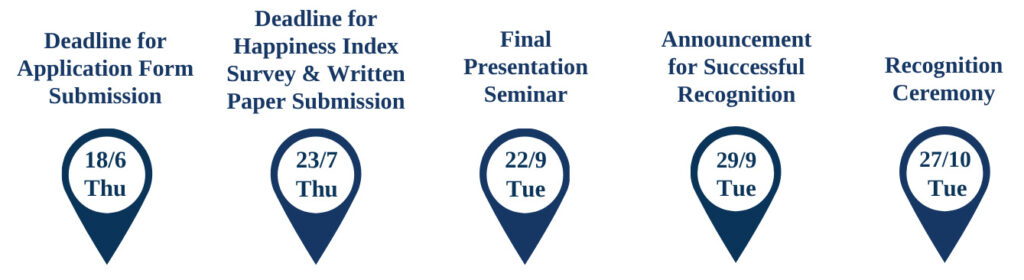
16. key dates
17. CHO RECOGNITION LOGO
All recognized companies can use the Chief Happiness Officer Recognition Logo in internal or external events to showcase recognition for their outstanding achievements in establishing a culture of happiness within the organization.
Add Your Heading Text Here
CHO Achiever Recognition Logo
All companies that have won the CHO Appreciation Award are authorized to use the CHO Achiever Logo, highlighting their outstanding practices in actively enhancing corporate culture.
CHO Master Recognition Logo
(Recognized for 5 consecutive years)
Companies that are recognized as CHO companies for 5 consecutive years will be granted the authorization to use the CHO Master Logo, showcasing their outstanding achievements in continuously improving corporate culture.

CHO Visionary Recognition Logo
(Recognized for 10 consecutive years)
Companies that recognized as CHO companies for 10 consecutive years will be granted the authorization to use the CHO Visionary Logo, showcasing their demonstrated commitment to a consistently exceptional corporate culture.
18. RENEWAL FEE
| Company Category | Renewal Fee |
Corporations (>50 employees) | HK$3,500 |
SMEs (≤50 employees) | HK$2,000 |
A 50% discount is offered to non-governmental organisations (NGOs) registered under Section 88 of the Inland Revenue Ordinance of Hong Kong.
19. JUDGING PROCESS
| Judging Process | Details |
Part 1 Application Form Submission (by 18 June 2026) |
|
Part 2 Happiness Index Survey Submission (by 23 July 2026) |
|
20. JUDGING CRITERIA – HAPPINESS INDEX SURVEY
The following criteria are taken into account for the survey. The organizations that achieve 70% or above will be continuously granted the CHO Recognition Logo till 31 December 2027. The objective of this study is two-fold:
- To build a Workplace Happiness Index that can sustainably capture the pulse of organizational health amongst employees.
- To provide evidence to show how some organizations are a thriving culture and proving the relationship between employee workplace happiness and business performance is the focus on the study.
21. CHO Corporate Culture & Brand Communication
22. Payment methods
Participation fee for Company Award, SME Award, CHO Special Awards & Individual Award, and Renewal fee for Recognition Logo Renewal Scheme can be settled on or before 26 June 2026 (Friday) by the following methods:
| i. Bank Transfer in HKD to | |
| Bank | Bank of China (Hong Kong) Limited |
| Beneficiary | CHIEF HAPPINESS OFFICER ASSOCIATION LIMITED |
| Account No. | 012-802-2-014682-4 |
| Remarks | Please mark your account number / name on the pay slip & email the pay slip to: info@choassociation.org or WhatsApp @ 6263 6263 |
| ii. By FPS | |
| Bank | Bank of China (Hong Kong) Limited |
| FPS Identifier | 100900554 |
| Remarks | Please email the FPS record to : info@choassociation.org or WhatsApp @ 6263 6263 |
| iii.By Cheque | |
| Cheque payable to | CHIEF HAPPINESS OFFICER ASSOCIATION LIMITED |
| Remarks | Please mail a crossed cheque to: Unit 901, 9/F, Tower В, New Mandarin Plaza, 14 Science Museum Road, Tsim Sha Tsui East, Kowloon, Hong Kong. |
Attachment - Promotional Fee
Top 10 Happy Companies to Work For AWARD, and Top 5 Happy SMEs to Work For AWARD
The winner will be required to pay a promotional fee of approximately HK$18,000. Complete details will be announced along with the winner announcement. Please refer to last year’s promotional package for reference.
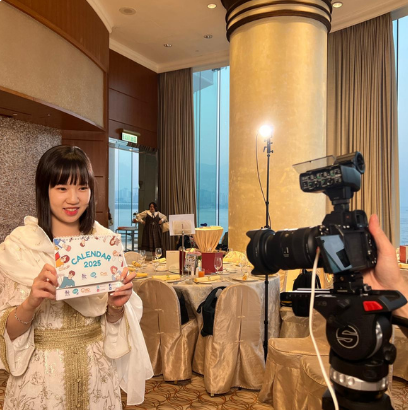
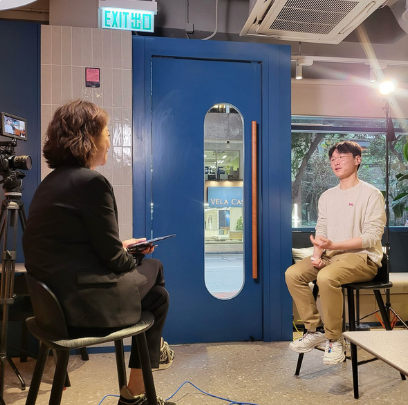
- Customized corporate culture promotional interview video to be published on the Association’s website, email channels, and social media platforms
- Featured article about the winning company will be published on the Association’s website and social media platforms (Highlighting your company’s core business and corporate culture through the award announcement)
- Award announcement distribution through media channels
- One-year usage rights of the CHO Recognition Logo
- One-year membership of the Chief Happiness Officer Association including exclusive benefits such as complimentary or discounted corporate coaching programmes

(Scan to View Previous videos)
Special Awards
The winner will be required to pay a promotional fee of approximately HK$5,800. Complete details will be announced along with the winner announcement. Please refer to last year’s promotional package for reference.
- Featured article about the winning company will be published on the Association’s website and social media platforms (Highlighting your company’s core business and corporate culture through the award announcement)
- Award announcement distribution through media channels
- One-year usage rights of the CHO Recognition Logo
(For details, please refer to the latest official announcement)
Enquiry
Ms. Mary Suen
Email:mary@choassociation.org
Contact:9608 8888
Ms. Chris Wong
Email:info@choassociation.org
Contact:6263 6263
CHOA Website https://choassociation.org/

CHOA Website